1.1 The question
Where this chapter is going
A car's wheel does not stay upright as it moves up and down. The angle it leans at, and the angle it points at, both change. The wheel is held by a linkage of arms that swing on the body.
That change is small — a couple of degrees over the whole travel — and it matters enormously, because a tyre grips best at a particular angle. So a suspension designer wants to know this before a single part is made. How will the wheel's angles move, and how much can the design be changed to suit?
This chapter's question. It is the chapter problem, and this section is the first step towards it. The step is the geometry that turns a wheel's rise and fall into an angle.
The second half of that question is where the chapter's argument lives. The first half has one answer. The second half is a judgement, and the chapter's argument is that the judgement can be made with numbers rather than with taste.
The object
Before the mathematics, the object. This is a front corner in cutaway, built for a display. It has an upper wishbone, a coil-over spring and damper, an upright carrying the hub, and the lower wishbone underneath it.
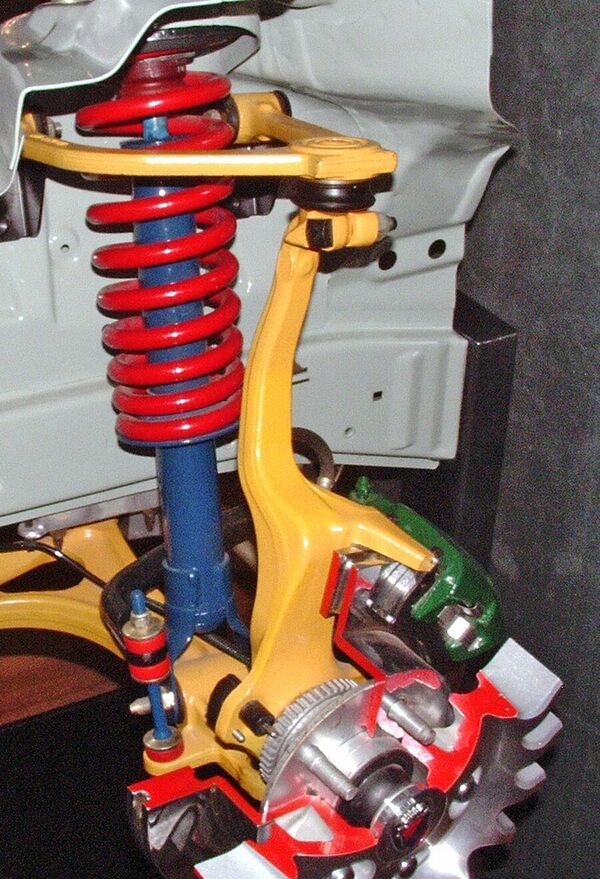
The parts are painted, which is a display's choice rather than a car's. On a real corner they are bare metal and covered in dust. What the paint is good for is showing which piece is which, and the shapes above are the shapes the chapter's model uses.
Photograph: a.d. Tramontana, CC BY-SA 1.0, via Wikimedia Commons; cropped. The image keeps its own licence.
The parts, and their names
Before the mathematics, the words. A car's front corner is a mechanism of seven parts. Every one of them will be referred to by name for the rest of the chapter.
Move through the parts with the buttons under the drawing. The names to keep are wishbone (also called an A-arm, because of its shape), upright, ball joint and contact patch.
The two wishbones each attach to the body at two points and to the upright at one. The upright carries the hub, and the wheel is bolted to the hub, so the upright and the wheel turn together. Everything in this chapter follows from that sentence.
Two angles that will be measured
A wheel has an angle in two different directions, and they have separate names because they do separate jobs.
Camber is the angle of the wheel in the view from in front of the car. A wheel standing straight up has zero camber. Positive camber means the top of the wheel leans out, away from the car. Negative camber means the top leans in.
Sign conventions differ between books, so this one states its own and keeps to it:
Toe is the angle in the view from above: whether the front of the wheel points slightly in towards the car or slightly out. This chapter meets toe only in passing, and §1.4 explains why: the front view is a projection, and a projection loses one of the two angles.
The chapter's four models
The mechanism stays the same all the way through. What changes is the model of it, and each model is replaced only when the one before it has stopped answering the question.
| Model | What it treats as rigid, and what as free | The question it can answer |
|---|---|---|
| One rigid triangle | the wishbone is one body, the upright another | where the wheel is, and at what angle |
| Two legs | the wishbone is written as its two legs | what a spare equation does to a model |
| Diagnosed | the same, read with a singular value decomposition | which equation was never needed |
| With a bush | the upper joint is a spring | how far the angles move under load |
The chapter's problem is answered at the end of §1.5, and §1.6 and §1.7 sketch what lies beyond that — mass, dampers, and the rest of the car.
A first look
The next section builds the first model, and the figure there shows the mechanism moving with the camber read off as it goes. It is worth knowing before then that the answer is not obvious. The wheel leans one way as it rises and the other way as it falls. Which way is a property of the linkage rather than a rule.
There is no agreement panel in this section, because there is nothing yet to agree with. From §1.2 onwards, every section ends by putting a number on how far the new model and the previous one differ.
You should now be able to
- name the parts of a double wishbone suspension, and say which of them are rigid
- say what camber is, and which way a wheel leans when its camber is positive
- say why the chapter asks two questions rather than one
Watch out
Positive camber leans the top of the wheel out. It is a common mistake to read it the other way round, and a whole chapter of signs then comes out upside down.
The check that settles it: a wheel with positive camber looks like the top of an
A that has been pushed outwards at the top. It looks like / \ seen from the
front of the car, leaning away from the middle. Every sign in this chapter
follows from that one convention, and the code that computes camber uses the
same definition.
Where the mathematics lives
The model in this chapter is a small one, and it has been implemented in a package that also solves the three-dimensional version. Each section shows the mathematics as pseudocode and links to the file that implements it. A reader who wants the whole of it can follow the link:
otkd— the solver, its tests, and the data the later figures draw.